Back
Back May 4, 2026
Flat Lay vs. On-Model Photos: Which Actually Converts Better?

Flat Lay vs. On-Model Photos: Which Actually Converts Better?
Most clothing sellers already know the answer to this question. On-model photos convert better. The harder question is whether the conversion lift is worth the cost-and what you do when it is not.
That is the real decision. Not which format is "better" in the abstract, but whether to keep shooting flat lay because on-model is genuinely out of reach, whether to spend on a model shoot and hope the math works out, or whether there is a middle ground that captures most of the upside without the $10,000-plus price tag.
This post walks through the actual conversion data, the real cost math on both sides, the cases where flat lay genuinely outperforms, and the options between flat lay and a full on-model shoot that most sellers overlook.
If you are still setting up your flat lay workflow, read our complete flat lay clothing photography setup guide first. If you are past setup and making the format decision, keep reading.
What Each Format Actually Is
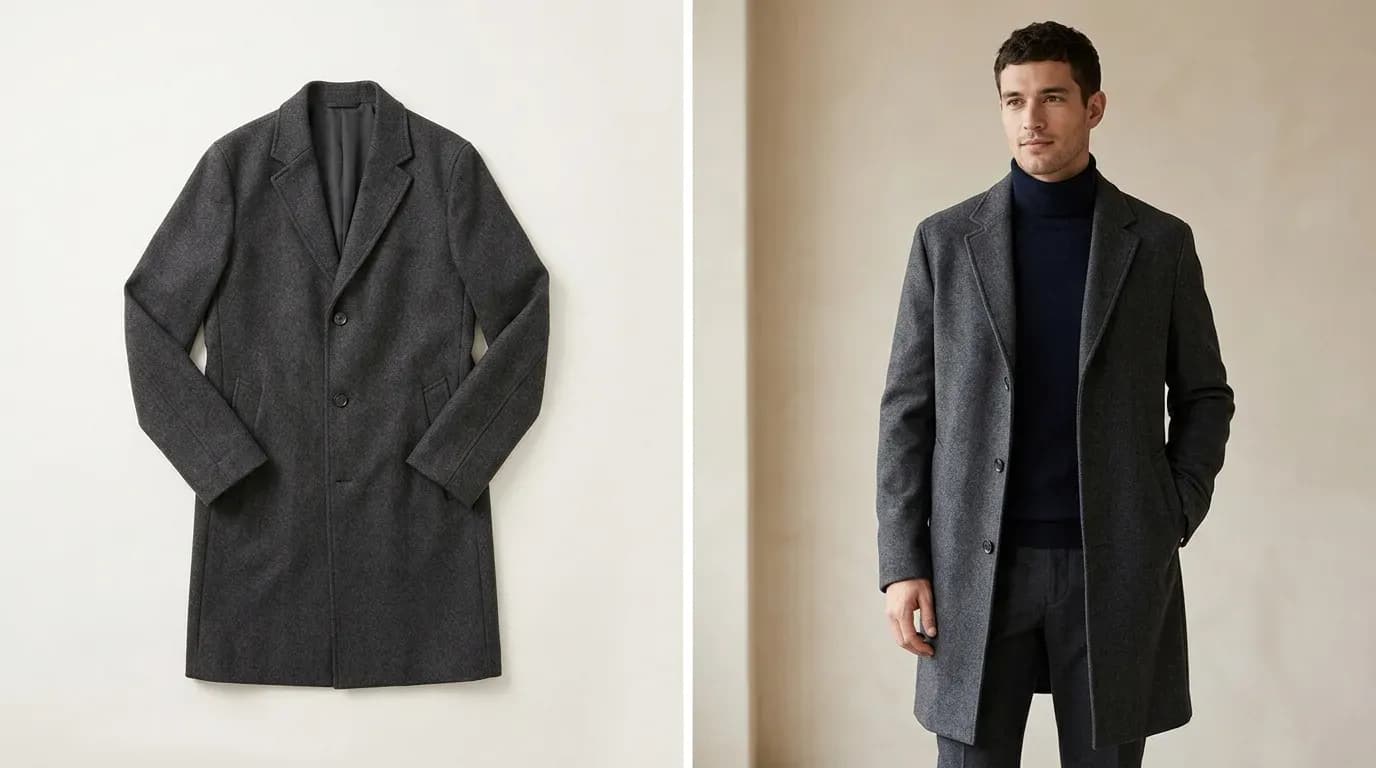
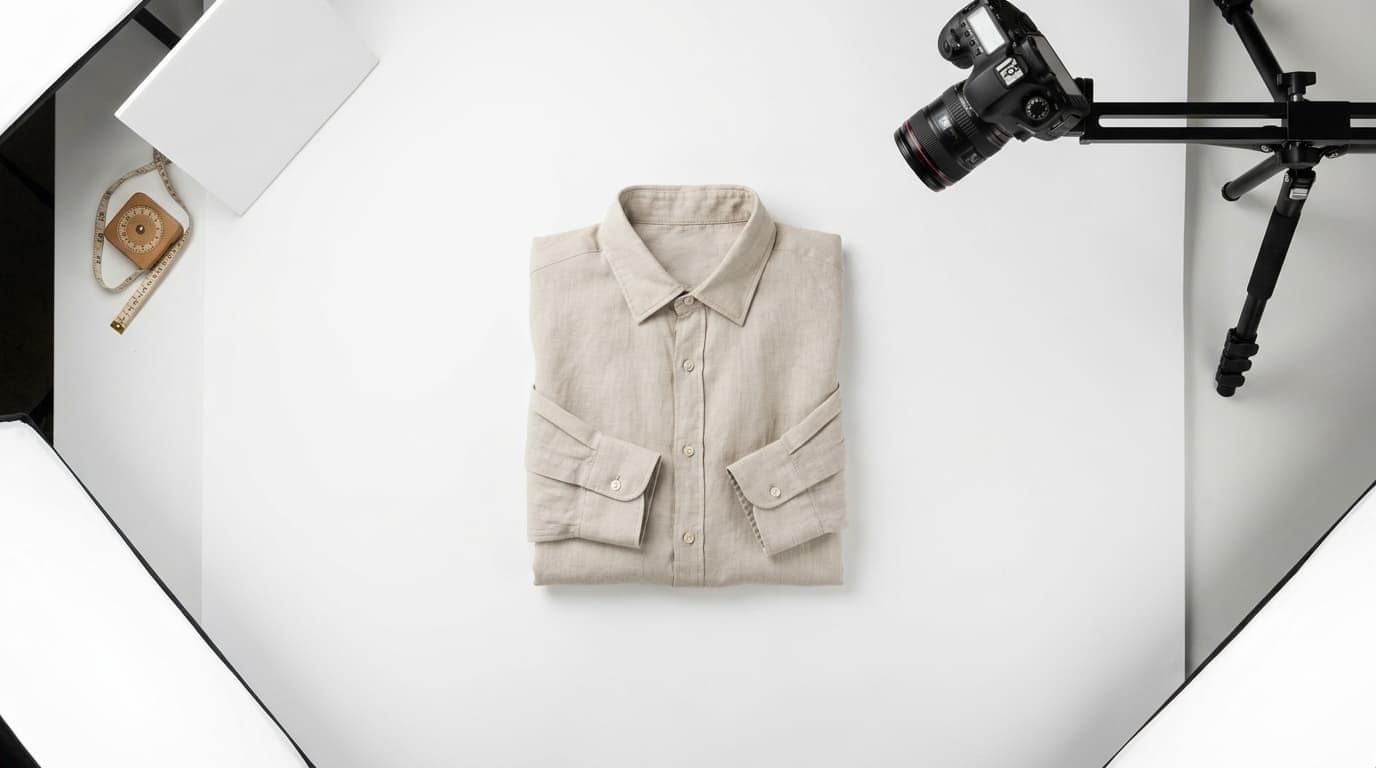
Flat lay photography-also called lay flat photography-is a product photography technique where garments are arranged on a flat surface and photographed from directly above. No body, no support structure, no model. The camera points straight down at the piece. Flat lay photography meaning in e-commerce: it is the format that shows color, pattern, and general silhouette, but tells customers almost nothing about how a garment fits or moves on a body.
On-model photography means the garment is worn by a human model and photographed in a studio or lifestyle setting. It shows fit, drape, proportion, and how the piece moves on a body. Customers can evaluate whether the garment suits their frame, how the sleeve length falls, whether the waist hits correctly.
Product photography flat lay vs model: one format shows what the product looks like. The other shows what it looks like on.
Both formats are legitimate. They serve different functions, convert differently, and cost very differently. The decision is not aesthetic-it is economic.
The Conversion Data
The numbers are consistent across studies. On-model and 3D product photos convert 20-30% better than flat lays. Click-through rates run 25-35% higher. Returns drop 15-25% when customers can see how a garment fits and drapes.
That last figure matters most. Fashion return rates average 24-26%, and the majority trace back to fit uncertainty. A customer who cannot tell from a photo whether a dress will sit at their waist or hip, or how a sleeve falls, is a customer who will either not buy or buy and return. Flat lay does not answer those questions.
Here is the important counterpoint: better photos do not automatically mean better conversion. One seller in the community spent $12,347 on a professional on-model shoot for roughly 40 pieces. Conversion went from 3.2% to 2.7%-worse, not better. The models did not resonate with the target customer. The higher-end aesthetic created a mismatch with the product and the audience. The money went the wrong direction entirely.
The lesson is not that on-model photography is unreliable. The lesson is that "more expensive" is not the variable. Resonance with your specific customer is. A well-shot flat lay of an accessory will always outperform a disconnected on-model editorial for that category. The format choice has to match the product and the customer, not be applied as a blanket rule.
The Real Cost Math
Understanding on model vs flat lay photography starts with understanding what each format actually costs in full.
Flat lay costs:
- DIY: $0-$2 per image once your setup is in place. The primary costs are equipment (a one-time investment) and time. For a 100-SKU catalog, a practiced solo operator can shoot and edit in two to three days.
- Outsourced: $5-$15 per image for a photography-and-editing service. At 100 SKUs, that is $500-$1,500.
For brands building a fashion product photography workflow at volume, flat lay is the production-viable format-fast, repeatable, and scalable without proportional cost growth.
On-model costs-the visible number:
- Professional studio day rate: $500-$3,000 depending on location and photographer
- Model fee: $300-$800 per half-day for a professional model
- Hair and makeup: $150-$400 per session
- Creative direction and styling: sometimes included in the day rate, often not
A seller quoted $40 per image for a professional on-model shoot is seeing the per-image math after dividing the total session cost across all the pieces shot. That number is real-for pieces that photograph cleanly, require no reshoots, and fill every slot in a tight schedule.
The realized cost is different. Account for setup time, breaks, garment changes, and the pieces that need reshooting, and that $40 per image becomes $84 per image on average. For a brand with 500 SKUs refreshing annually, the true photography cost runs $125,000-$250,000 per year before accounting for new launches or seasonal updates.
For brands with a limited catalog, strong average order value, and a customer base that responds well to editorial content, that investment can generate positive ROI. For the rest, the math rarely works.
When Flat Lay Actually Wins
Flat lay is not the inferior option in every case. There are specific situations where flat lay outperforms on-model or where the conversion gap shrinks to a point where the cost difference is decisive.
Accessories and jewelry. A necklace, pair of earrings, or belt photographed on a styled surface is often more legible than the same piece photographed on a person. The garment-fit question does not apply. Flat lay frequently wins here.
Folded knits and basics. A crew-neck sweater or plain T-shirt where color and texture are the primary decision factors. Customers know what a basic looks like on a body. Flat lay delivers the color information accurately and efficiently.
Low average order value items. If your AOV is $15-$25, the economics of on-model photography almost never work. The conversion lift does not pay back a studio day rate at those margins. Flat lay is not a compromise-it is the correct business decision.
Lookbooks and editorial content. Flat lay photography for Instagram and Pinterest is a format choice, not a conversion optimization. Styled flat lay-with props, coordinated accessories, seasonal color stories-performs well for brand-building content where the on-model conversion question is irrelevant.
High-volume catalogs with frequent updates. A brand adding 50 SKUs per week cannot run every piece through an on-model shoot. Flat lay is the production-viable format for high-velocity catalogs.
When On-Model Wins Decisively
There are garment types where the flat lay vs on model conversion gap is not 20-30%. It is larger, and the return rate differential is the proof.
Fit-critical apparel. Structured blazers, tailored trousers, fitted dresses, and outerwear. The key question customers are asking is: does this fit? Flat lay cannot answer that. On-model photography-or any format that shows the garment on a body-is not optional for these categories if conversion and return rates matter.
Swimwear. The entire purchase decision is about fit, cut, and how the garment looks on a body. Flat lay swimwear photography is, functionally, a pattern image.
Premium brand positioning. Flat lay communicates accessible and affordable. If your brand positioning is premium-if price points, materials, and brand voice signal quality-flat lay photography undercuts that positioning regardless of how well it is executed.
High-return-rate SKUs. If specific garments are generating disproportionate returns, on-model photography is the first intervention before markdown or discontinuation. Customers are signaling that they are guessing at fit. Better fit visualization reduces that.
The Middle Ground: Ghost Mannequin
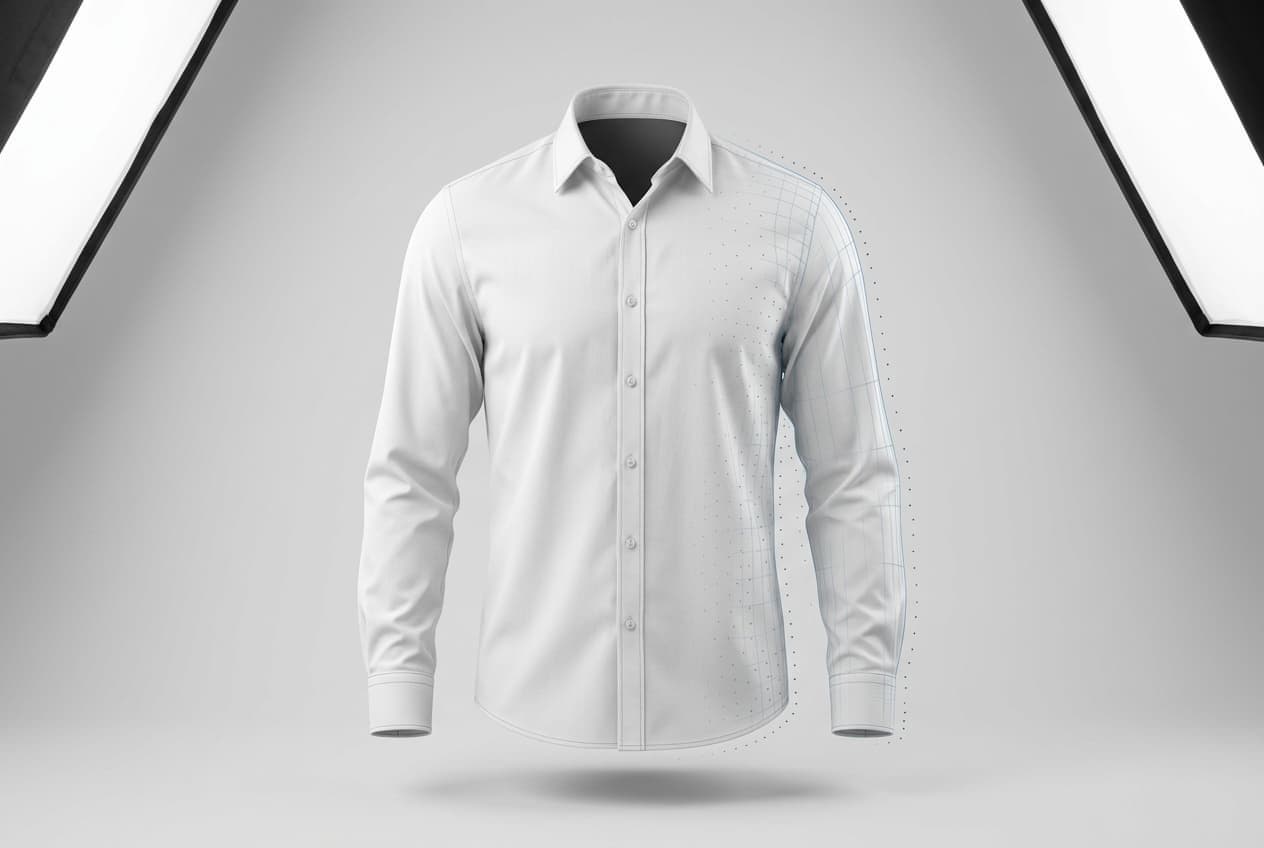
Between flat lay and a full on-model shoot sits ghost mannequin photography-the invisible mannequin technique that shows garments in 3D without a model. A garment photographed on a removable mannequin, then composited in post-processing, produces the hollow, "worn by an invisible body" look that delivers around 10-15% conversion lift over flat lay at a fraction of on-model cost.
Ghost mannequin gives customers the structural information they need: how the collar sits, how the sleeve falls, how the garment fits through the torso. It does not answer "does this suit my body type?" the way on-model does, but it closes most of the fit-signal gap.
The traditional ghost mannequin method-mannequin, studio, Photoshop compositing-runs $3-$50 per SKU depending on whether you DIY or outsource. It requires equipment, technical skill, and consistent shooting conditions. For the full breakdown of how the technique works, our complete ghost mannequin effect guide covers all three methods. For a direct comparison of every outsourcing option with real pricing, our ghost mannequin services comparison covers the field.
Ghost mannequin works. For brands that have the workflow and the volume to justify the setup, it is a legitimate answer to the flat lay conversion gap without on-model cost.
The New Middle Ground: AI Flat-Lay-to-On-Model
The more recent option changes the math most dramatically. AI tools can now take a flat-lay photograph and produce on-model output-the garment shown as if worn on a real body-without a model, studio, or mannequin.
The core question it answers: what if you could get on-model conversion lift at flat lay cost?
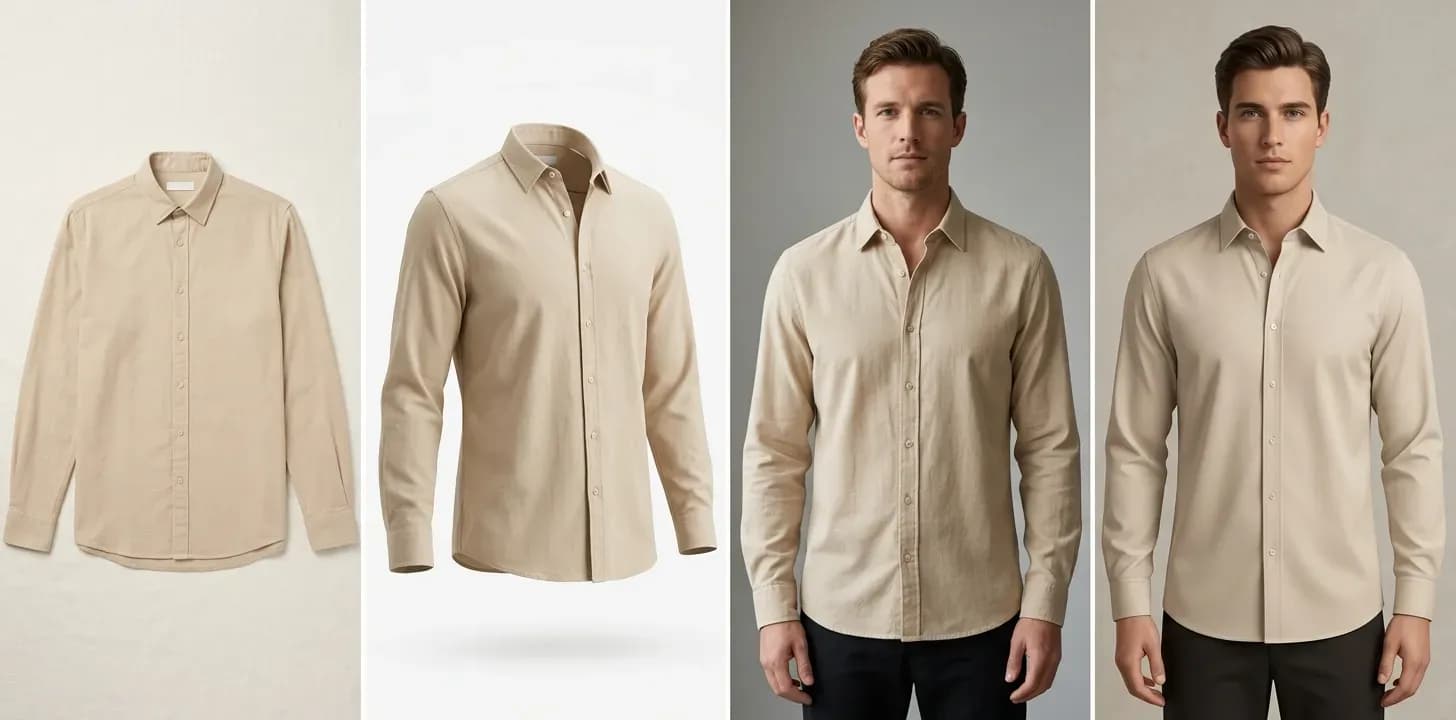
FuturMotion's fashion AI is built specifically for this use case. Upload a flat-lay photo. The AI applies fabric-aware processing-trained on garment geometry and drape, not generic scenes-and generates on-model product photos showing accurate fabric behavior, natural body proportions, and consistent lighting. The same flat-lay input also produces Living Motion video: the garment animated with fabric-aware motion for Reels, TikTok, and Shorts.
From a single flat-lay photo, FuturMotion produces:
- On-model photos across different body types
- Ghost mannequin and invisible mannequin output via the AI ghost mannequin alternative
- Virtual Try-On for interactive shopping experiences
- Living Motion video for social media content
- Background-removed marketplace images via AI background removal for fashion
Cost: Plans start at $25/month (Basic, 2,000 credits) and $49/month (Creator, 5,000 credits). At the Creator tier, a brand running 200 SKUs through the platform pays roughly $0.50 per image-compared to $40-$84 for a comparable on-model shoot. The per-image math is not close.
Over 500 fashion brands use FuturMotion to convert flat-lay catalogs into on-model and motion content without a production budget.
Decision Framework
Use product type, average order value, and catalog velocity to make the call:
| Situation | Recommended Format |
|---|---|
| Accessories, jewelry, low-AOV basics | Optimized flat lay |
| Fit-critical apparel, small catalog, can afford studio | On-model shoot |
| Mid-range catalog, mannequin already in workflow | Ghost mannequin |
| High-volume, 100+ SKUs, no production budget | AI flat-lay-to-on-model |
| Premium brand, structured garments | On-model or AI on-model |
| Testing new SKUs before committing to a shoot | AI on-model |
| Social content alongside product listings | AI + Living Motion video |
Format Comparison Table
| Flat Lay | Ghost Mannequin | On-Model Shoot | AI On-Model (FuturMotion) | |
|---|---|---|---|---|
| Cost per image | $0-$2 DIY / $5-$15 outsourced | $3-$50/SKU | $40-$84 realized | ~$0.50 |
| Cost for 100 SKUs | $0-$200 | $300-$5,000 | $4,000-$8,400 | ~$50 |
| Time to publish | Hours | 24-72 hrs (outsourced) | 1-2 weeks | Under 60 seconds |
| Conversion lift vs. flat lay | Baseline | ~10-15% | 20-30% | On-model range |
| Return rate reduction | Baseline | Partial (shows structure) | 15-25% | 15-25% |
| Scalability | High | Moderate | Low | High |
| Video output | No | No | No | Yes (Living Motion) |
| Best for | Accessories, basics, high-velocity catalogs | Mid-range catalog, mannequin in workflow | Premium, fit-critical, small catalog | Any catalog, especially high-SKU volume |
Frequently Asked Questions
What is flat lay photography in fashion?
Flat lay photography-also called lay flat photography-is a product photography technique where garments are laid on a flat surface and photographed from directly overhead. The camera points straight down at the piece. Flat lay photography meaning in fashion e-commerce: it is the format for showing color, pattern, and general silhouette without a model or support structure visible in the frame.
Flat lay is the most common starting format for small and mid-size clothing sellers because it requires minimal equipment and no additional people. The tradeoff is significant: it provides little information about how a garment fits on a body, which is the primary question driving purchase decisions in most apparel categories.
Does on-model photography convert better than flat lay?
Yes, consistently. On-model photos convert 20-30% better than flat lay across the apparel category, with click-through rates 25-35% higher. The mechanism is straightforward: customers can evaluate fit, drape, and proportion from on-model photos. They cannot from flat lay. For fit-critical garments-dresses, structured outerwear, swimwear-the gap is wider. For accessories and non-fit-critical basics, the gap shrinks.
The caveat: conversion lift depends on resonance between the model presentation and your actual customer. A $12,347 professional shoot can produce worse conversion than the flat lay it replaced if the editorial aesthetic mismatches the product or the audience. On-model photography increases the ceiling; it does not guarantee the result.
How much more does an on-model photoshoot cost than flat lay?
Flat lay runs $0-$2 per image for DIY and $5-$15 outsourced. A professional on-model shoot is typically quoted at $40-$60 per image, but realized costs-accounting for setup, reshoots, and non-productive shoot time-average $84 per image. For a 500-SKU brand, annual on-model photography runs $125,000-$250,000. Flat lay for the same catalog runs $0-$30,000 depending on whether you shoot in-house or outsource.
The gap between the quoted rate and the realized cost is where most sellers are surprised. The $40/image quote assumes a perfectly efficient shoot. It rarely is.
When should I use flat lay vs. on-model photos?
Use flat lay for accessories, jewelry, folded basics, low-AOV items, and situations where you need catalog volume at speed. Use on-model when selling fit-critical garments-dresses, blazers, structured outerwear, swimwear-where customers need to see proportions and drape to make a purchase decision.
When you cannot afford a full on-model shoot but are losing conversions on fit-critical pieces, ghost mannequin and AI on-model are the middle-ground options. The decision framework table above gives the full breakdown by situation.
Can AI turn flat lay photos into on-model shots?
Yes. Purpose-built fashion AI-trained on garment geometry and fabric drape specifically-takes a flat-lay photograph and produces on-model output showing the garment as if worn. This is meaningfully different from generic background-removal tools, which produce a cutout, not an on-model image.
FuturMotion's fashion AI generates on-model photos, ghost mannequin output, and Living Motion video from the same flat-lay input at roughly $0.50 per image. The platform applies fabric-aware processing, which preserves accurate drape and garment structure-the specific details where generic AI tools and background removers consistently fail on clothing.
Do flat lay photos hurt conversion on Amazon, Shopify, and Etsy?
It depends on the product. For garments where fit is the primary purchase consideration-structured jackets, dresses, anything where "how does this look on a body?" is the customer's core question-flat lay leaves conversion on the table across all three platforms.
Amazon specifically weights click-through rates in search ranking. Lower-CTR flat lay images on fit-critical garments compound into lower visibility over time-a conversion problem that compounds into a discoverability problem. For accessories and basics on these platforms, the impact is smaller. The format decision should follow the product, not the platform.
What return rate impact do product photos have?
Fashion return rates average 24-26%, and fit uncertainty is the primary driver. Product photography that provides fit information-on-model, ghost mannequin, or AI on-model-correlates with a 15-25% reduction in returns compared to flat lay. For a brand doing $500,000 in annual revenue with a 25% return rate, a 15% reduction in returns represents roughly $18,750 in recovered margin annually.
Returns also damage marketplace seller ratings and increase logistics costs, so the downstream impact of poor fit visualization extends well beyond the immediate refund.
Is ghost mannequin a middle ground between flat lay and on-model?
It is. Ghost mannequin photography-also called the invisible mannequin effect-shows a garment in 3D with the collar, sleeves, and torso visible as they would sit on a body, without a model in the frame. It delivers approximately 10-15% conversion lift over flat lay and costs significantly less than a full on-model shoot: $3-$50 per SKU depending on method.
Ghost mannequin does not answer "does this suit my body type?" the way on-model does, but it closes most of the structural information gap that flat lay leaves open. For a full breakdown of methods, costs, and where each approach breaks down, our ghost mannequin effect guide covers every option.
What to Do Next
The format choice compounds over time. A catalog built on flat lay for fit-critical garments is leaving conversion and margin on the table for every month it stays that way. A catalog built entirely on on-model shoots is locked into a cost structure that does not scale as SKU count grows.
The practical path for most clothing sellers: keep flat lay for the product types where it genuinely works-accessories, basics, high-velocity additions. For fit-critical garments, invest in ghost mannequin if the workflow is already in place, or use AI to close the gap. FuturMotion's ghost mannequin alternative and fashion AI platform convert your existing flat-lay photos into on-model imagery and motion content from $25 per month.
You do not need a $10,000 shoot to get on-model conversions. You need the right tool for the right product.
Related Articles
Read our other article
Dive into more guides to help you grow
May 28, 2026How to Photograph Clothes to Sell Online (2026 Guide)
Compare all 4 clothing photography methods by budget and skill - flat lay, ghost mannequin, on-model, and AI - and find the right approach for your catalog.
 Apr 28, 2026
Flat Lay Clothing Photography: Complete Setup Guide for Ecommerce
Set up flat lay clothing photography on any budget - gear, lighting, styling, and a practical path to upgrading flat lays into on-model shots with AI.
 Apr 22, 2026
AI Ghost Mannequin: How to Create the Effect in Seconds (No Photoshop)
Learn how AI ghost mannequin tools work, step by step - what the AI reconstructs, which garments it handles best, and where it still has limits.